Background
AlphaFold is an AI system developed by Google DeepMind that predicts a protein’s 3D structure from its amino acid sequence. It regularly achieves accuracy competitive with experiment.
Google DeepMind and EMBL’s European Bioinformatics Institute (EMBL-EBI) have partnered to create AlphaFold DB to make these predictions freely available to the scientific community. The latest database release contains over 200 million entries, providing broad coverage of UniProt (the standard repository of protein sequences and annotations). We provide individual downloads for the human proteome and for the proteomes of 47 other key organisms important in research and global health. We also provide a download for the manually curated subset of UniProt (Swiss-Prot).

Q8I3H7: May protect the malaria parasite against attack by the immune system. Mean pLDDT 85.57.
In CASP14, AlphaFold was the top-ranked protein structure prediction method by a large margin, producing predictions with high accuracy. While the system still has some limitations, the CASP results suggest AlphaFold has immediate potential to help us understand the structure of proteins and advance biological research.
Let us know how the AlphaFold Protein Structure Database has been useful in your research, or if you have questions not answered in the FAQs, at alphafold@deepmind.com.
If your use case isn't covered by the database, you can generate your own AlphaFold predictions using this open source code, which also supports multimer prediction.

What’s new?
AI-derived residue annotations – October 2026
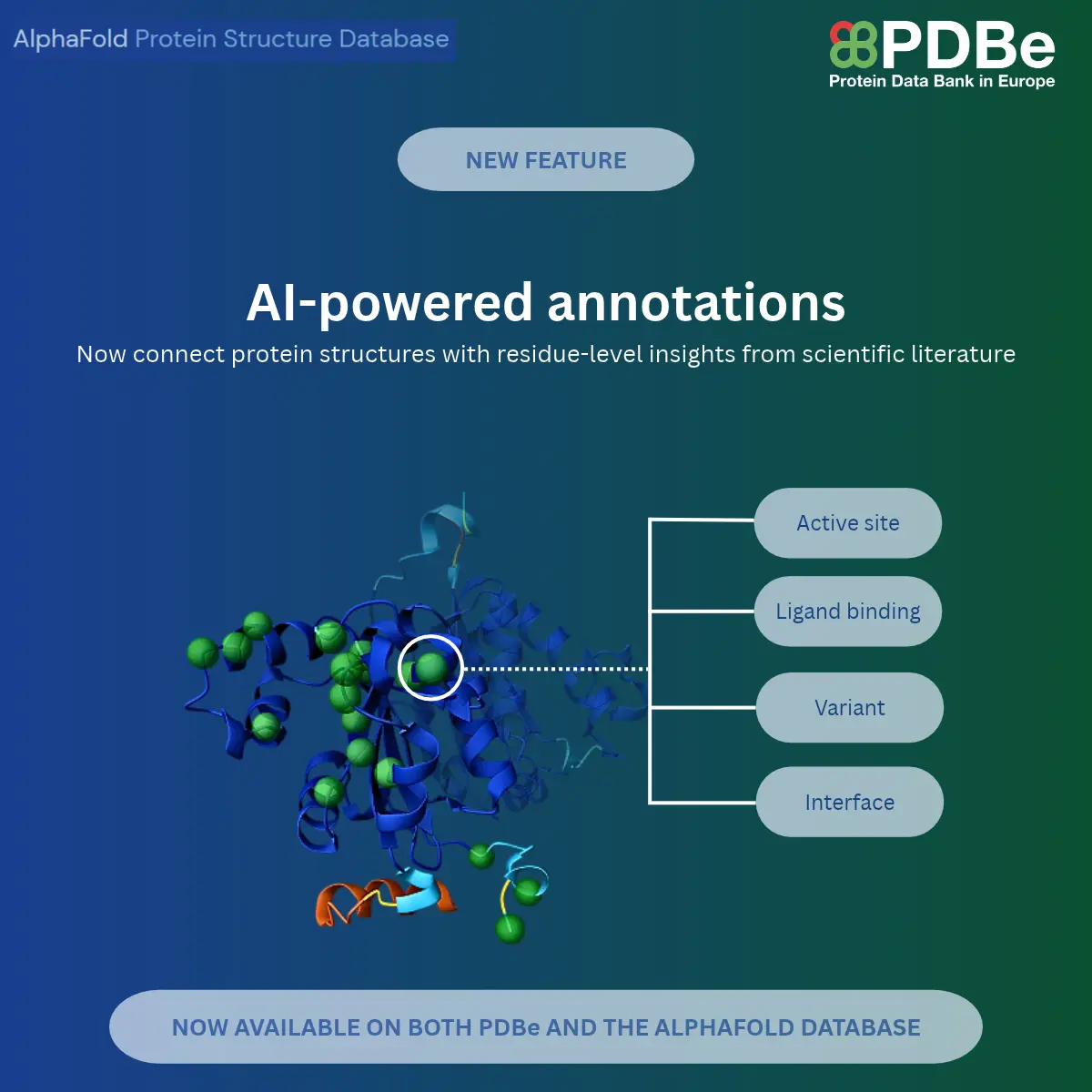
AlphaFold Database now integrates AI-derived residue-level annotations from the scientific literature, providing biological context for individual residues alongside predicted protein structures. A transformer-based named entity recognition (NER) model identifies protein residues and point mutations in structural biology publications and links experimentally supported annotations to UniProt reference sequences.
Annotations are transferred from experimentally validated PDB structures to AlphaFold models using the SIFTS framework, ensuring that literature-derived residue annotations are supported by experimental evidence.
This release enables users to navigate directly from residues in AlphaFold predictions to publications describing their function, interactions, and experimentally observed mutations, making it easier to interpret predicted structures in their biological context.
Read more about text-mined residue and point mutation annotations 
What’s next?
We plan to continue updating the database with structures for newly discovered protein sequences, and to improve features and functionality in response to user feedback. Please follow Google DeepMind's and EMBL-EBI’s social channels for updates.
Licence and attributions
Data is available for academic and commercial use, under a CC-BY-4.0 licence.
EMBL-EBI expects attribution (e.g., in publications, services, or products) for any of its online services, databases, or software in accordance with good scientific practice.
If you use this resource, please cite the following papers:
Note: A given structure may be associated with further publications. For authoritative information regarding the relevant publication(s), please consult the dataset collection or the structure metadata provided on the entry page.
If you use data from AlphaMissense in your work, please cite the following paper:
AlphaFold Data Provided by GDM:
AlphaFold Data Copyright (2022) DeepMind Technologies Limited.
For AlphaFold Data provided by third party data providers:
- Kinetoplastid data copyright (2025) Wheeler Lab
Wheeler RJ. A resource for improved predictions of Trypanosoma and Leishmania protein three-dimensional structure. PLoS One (2021) - AllTheBacteria data copyright (2025) AllTheBacteria Consortium
Hunt M, Lima L, Anderson D, Bouras G, Hall M, Hawkey J, Schwengers O, Shen W, Lees JA, Zamin Iqbal Z. BioRXiV (2025) - A BFVD Data Copyright (2025) The BFVD Development Team
Kim, RS et al. BFVD—a large repository of predicted viral protein structures. NAR (2024) - Viro3D dataset (2025)
Litvin, U et al. Viro3D: a comprehensive database of virus protein structure predictions. Mol Syst Biol (2025) - VAD dataset (2026)
Odai, R., Leemann, M., Al-Murad, T., Abdullah, M., Shyrokova, L., Tenson, T., Hauryliuk, V., Durairaj, J., Pereira, J., Atkinson, G.C. The Viral AlphaFold Database of monomers and homodimers reveals conserved protein folds in viruses of bacteria, archaea, and eukaryotes. Science Advances (2025)
AlphaMissense Copyright (2023) DeepMind Technologies Limited.
EMBL-EBI training
Recorded webinar
Accessing and interpreting predicted protein structures from AlphaFold database
Online tutorial
AlphaFold


